Showing posts with label artist. Show all posts

Friday, February 24, 2017

I titled it "Spending Time"

Today I read a conversation between artists David Horvitz and Alexandar Provan wherein the topics of time and space - as delineated by modern society - are challenged or re-explored so as to perhaps find oneself unconfined by the ideas.  After all, we can mostly all agree that time and spacial organization are tools that we've devised to organize ourselves and do not actually exist apart from our mutual understanding and agreement.  There was a time (haha) when we knew approximately what time it was simply by the appearance of a star on the horizon line or by a cast shadow.  In that era, intuition and the reflexive "body clock" were still of great relevance compared to modern life - wherein we stay up all night working because the deadline is tomorrow and we need global synchronicity (ie: working simultaneously with partners in Japan) to stay ahead (of?).  Yikes!  Always trying to get ahead.  The "keeping up with the Jones" theory morphs into global competition.  What a huge drag!  How completely exhausting!
This Victorian era "clock" designed to tell time based on the moments in the day when flowers bloom should give a lift after that depressing thought:
Swedish botanist Carl Linnaeus proposed use of this time keeping device in Philosophia Botanica (1751)
All that to bring up what I thought as I was reading about the irrelevance or pliability of time and space - two things: 1. I've recently learned the technique of transcendental meditation which seems to exist in a space of no time and 2. I titled my first cross stitch double portrait of myself and husband "Spending Time" - more on that....

The experience of transcendental meditation has been somewhat miraculous to me in that I haven't ever felt the way I feel while practicing this meditation.  All other types of meditation have left me feeling frustrated and wondering if "it's working" or if I'm really doing anything to help my most basic anxieties.  This technique seems to do as it's named, transcend.  I actually don't experience time (even though my thoughts are going on and on just as "normal"). Instead, there's this inexplicable experience of all and none, here and nowhere, now and forever.  I have a short, set amount of time that I'm shooting for to spend meditating and it's important that I don't meditate all day, but the precision of time just doesn't matter.  It's the activity that takes precedence and must be repeated twice daily along the rise and fall of my typical human energy levels and moods.

The more personal realization of how I work on my artwork as a timeless technique came to mind as well.  I'm currently working on the 2nd (of what may be a series of) cross stitch double portraits of myself and my husband.  There are almost 41,000 stitches equaling the number of pixels in the 10" x 16" photograph I am reproducing.  When I did the first one, titled "Spending Time," I approached it much like the honoring meditations of my repetitive artworks before it.  Spend a lot of time working on it through a repeated action, practice precision and contemplate the work as it slowly evolves however sometimes frustrating or other times freeing.  To me, this idea correlated with my understanding of myself in a long-term (marriage) relationship.  However sometimes freeing or other times frustrating, it's all time, spending time, it's an accumulation of everything all intermingled together into one big jumble of "us."  And then, there's the "no time."  I'm reminded of the buddhist "no mind." There's also the "no us" and the "no me."  The slowness of making my art also flies in the face of contemporary art making practices which run along the same rat race (art market) as the rest of our capitalism based self making.  I realize that I am just NOT cut out for that race.  So, as long as there is "no time" and  I'm "spending time" I'll be taking care of the otherworld, perhaps the neitherworld (like Horvitz captures) of the Art world.
Working on my self.

Tuesday, January 31, 2017

Art and practice.

Speaking of books, another book I have been reading is Buddha mind in contemporary Art, a collection of essays and interviews regarding the relationship of Buddhism to art making and artworks.  There are so many valuable and inspiring commentaries by artists, critics, curators, and just art "people "in this book that it is difficult to choose one idea to share here.  I picked up the book because of a curator I liked - a few of his writings I'd read just rang true to me.  I've  always been interested in Buddhism, so this book has proven inspiring to me as it addresses, from various points of view, the  remarkable similarity between mindfulness practice and art making.

When I was in college, I studied printmaking and fiber arts as I was magnetically pulled toward those  repetitive disciplines.   Much like my love for running as exercise, hiking, and other sustained, contemplative activities, I was unaware of how my art-making resembled mindfulness practice and pointed to my essential desire to create space in my own mind and cultivate the mental state of flow.

 Upon introduction to meditation technique, I realized my art making was so similar. I also realized my art making could provide context and  inspiration for mindfulness as the end result is a product that continues to exist beyond my own contemplative practice. So I started to make  art, however sophomorically, that pointed toward these ideas I was learning in a novice Buddhist study.  I still love many of those well intentioned works.

In my recent years of having stepped away from the art community, I find (through reading, art making and learning new art 'languages' such as piano and Spanish),  that my mindfulness practice is stronger and more important to me than ever.  As a student, I was not fully aware of the potential for mindfulness practice in my art making, but over time I see there is always an unfolding realization of this essential aspect of my work.   Perhaps the only purpose of art making for me is to cultivate and present the possibility for mindful living.
Current progress in my time of slow contemplation of my marriage, the "spending time" that is "us" and that unequivocally builds my awareness for our growth (with all it's rises and pitfalls) as partners.

Saturday, April 30, 2016

the inner critic

Most people have voices in their head whether they are conscious of the voices or not.  Obviously, hearing voices can become extreme for some to the point of neurosis or worse, schizophrenia, but I am referring to a normal inner dialogue as it flows through our thoughts.  Sometimes we are not aware of the multiplicity within ourselves and we can be unknowingly influenced by thoughts (inner messages to ourself from ourself) such as judgements, biases, fears, obsessions.  This is putting it quite simple and the matter is truly more complex, but I mean to address the inner voice of the critic.

For myself, the inner critic showed up very early in my life (perhaps around the age of 6?), and represented a compass for finding acceptance from the world outside myself.  I believe this is a common condition with children and young people wherein, we find that we can get through this world much easier if we can just find out what other people like, accept, enjoy, approve, and generally believe successful.  These external influences collect into what Freud called the SuperEgo - the moral regulator! - and it's up to us to find out how those internalized impressions and expectations either work for us or against us.  Each of us also has an unique internal orientation that works with or against the external orientation - altogether, our inner leanings and our outer parameters are the basis for our decisive powers.  External orientation may work well within our family, school, and workplace but can fail us as we expand our connections and communities and begin to feel pulled in different directions without knowing which is right or best for us.  Further, despite lack of practice with inner orientation, the inner knowing (call it "gut feelings," intuition, and at best, essential Self) is nevertheless there.  Without our consciousness for it or choosing to engage this inner orientation into the authorship of our own life, we can feel tension as the external orientation of our Superego can conflict with our unique inner knowing.

I am thinking of the ways in which, as an artist, I have resisted inclinations to make some kind of art because the inner critic (made up of external codes and voices from throughout my early life) hinted at some absurdity in my inclination.  I think of all the times I have attempted to reach something deeper in my creative work and the difficulty and the unfamiliarity of the creative terrain raised red flags with the SuperEgo.  I am halted in my exploration of my prima materia as the part of me that has to "fit into the world" demands that I "use my time wisely" and focus on more practical skills.   How does anyone actually engage in creative work, the response to exploring one's prima materia, if the conscious mind, oriented by conventional rules, does not permit opening the door to one's unconscious dwelling?

I've been reading a selection of Carl Jung's essays regarding creativity, imagination and, of course, the work of psychoanalysis, and he speaks of the inner critic as a "cramp" in consciousness.  Yes, I find that the inner critic (voicing, "Why am I doing this?" or "How is this weird work valuable in the 'real' world?" as I try to make my art) is most definitely a cramp!  As with a cramp during exercise, we must learn to take care of the cramp in order to continue with our work.  A cramp should not stop us from ever exercising again!  Likewise, a mental cramp can not keep us from engaging with our irrational mind and thereby engaging our creative work.  In discussing this matter with a musician the other day, he talked of practicing scales for as long as he needed in order to pass beyond the physical and practical work of it and begin to hear the potential for creating music.  Artists may have to engage with the base material of their work for totally irrational amounts of time in order to achieve the alchemical potential that exists between themselves and their media.  Meanwhile the Superego objects, "Spending 3 hours practicing music scales to then be able to compose?!  Do we really have 5 hours to spend on music today?"  The answer, for an artist of any kind is, irrationally, YES!
Cross-stitch for months... and months... and so much time that the artwork becomes the time spent.  My external rules of "using time wisely," the SuperEgo heckles me from my shoulder, "Why are you spending so much TIME on this project?!" and I have to think in response, because I am an artist, and this is my work.

Though seemingly an obvious idea, often a forgotten imperative of the artist is that doing creative work is of utmost importance to the artist.  We forget how imperative the work is as the rational (industrial, capitalist, media driven) world opposes the irregular, irrational and costly work of art-making.  How many conversations have I had with artists where they actually say, "I have to make my work.  Otherwise, how would I live?  I would die."  It's not a matter of fitting into a schematic of practical use and monetization.  It's a matter of realizing one's need to work with unconscious material (that which comes from within and does not follow the codes of the rational world) because otherwise, it would eventually mount up within us and consume us with it's energy.  Better to engage with it regularly and make it workable and useful within the context of our creative work.  The creative work then becomes the actualization of the whole person, the irrational material of the unconscious balanced by the systems and skill sets of the conscious ego.

Some may believe that creative work is not about the actualization of the whole person and can exist in the realm of practical work.  This is plausible, but I am not that artist.  There are enough aesthetically designed objects in this world without my making my artwork so practical and prolific and commonly available in the lives of many (this practicality is the kind of resistance my Superego puts upon me).  I find resonance in Jung's words, "Everything good is costly, and the development of personality [unique selfhood] is one of the most costly of all things.  It is a matter of saying yea to oneself, of taking oneself as the most serious of tasks, of being conscious of everything one does, and keeping it constantly before one's eyes in all its dubious aspects - truly a task that taxes us to the utmost."

The inner critic says, "The task is too much; we need not dive so deeply.  There is plenty of creative work to do without going so far."  But I willfully say, the work of the artist is to dive into the unconscious depths and trust that the inner critic can become instead the tether that keeps us connected with our conscious realm.

All references to Jung's writing in this post are specific to an excerpt from Alchemical Studies (1929) (CW 13) pars. 17 - 45

Monday, March 28, 2016

emerging avant garde?

Having recently re-read my post stillness from January, it is truly wonderful to now read this commentary by Art Critic, Andrew Berardini.  Instinctually, I know that the Art-professionalism-trend is a horrific distraction from art making and living artfully.  Hence, struggling with pressure to become professional has always been...  a struggle. 
Perhaps there's more to think about regarding "professionalism" and taking oneself lightly? seriously? too seriously?
Once again, these rational terms compete with the abstract matter of art and with the often irrational nature of the working artist.  

Read on: 

HOW TO BE AN UNPROFESSIONAL ARTIST
By Andrew Berardini
March 23, 2016
No one likes being called an amateur, a dilettante, a dabbler.

“Unprofessional” is an easy insult.

The professional always makes the right moves, knows the right thing to say, the right name to check. Controlled and measured, the professional never fucks the wrong person or drinks too much at the party. They never weep at the opening, never lay in bed for days too depressed, sick, broken to move. They say about the professional, “so easy to work with” or “so exacting but brilliant.” The professional takes advantage from every encounter, employs every new acquaintance as a contact, always hits the deadline. When asked about their work, they know what to say, a few lines of explanation sprinkled with enough filigreed intrigue to allude to abysses of research, the mysteries of making. They answer emails in minutes. Their PowerPoints are super crisp. Look at their website, so clean, so modern, so very pro.

You don’t feel like any of these things.

You are hungry, tired, overworked. You drank too much at the party and then slept with the wrong person, and then the really wrong person. You missed the deadline, it just thrushed past with a whoosh. Hustlers around you disappear into wealth and fame. Your dealer tells you to make more with red, those red ones are really selling. Maybe, she says, you make only the red ones for a while? Your student skips class to go to an art fair. The most pressing collectors are the ones holding your student loans. They keep calling, you wish you could trade them a drawing. It can take days to answer the simplest email. Your website, if it exists, is in shambles.

You wander. You doubt. You change styles, media, cities. You experiment, you fail. Again. And again.

Unprofessional most literally means “below or contrary to the standards of a paid occupation.” Who makes the standards? Is everyone paid? Fairly? Is being an artist a job or something else? Who sets these standards? Do you wish to be standardized?

Art and success.

So easy to cocktail those two words together into “professionalism.” Pull up a famous artist’s CV and work from the beginning. Does success look like a sculpture plunked outside the Palace at Versaille? Is it a biennial, a prize, a blue-chip dealer? Is it the cover of a magazine, a thick, chunky retrospective catalogue? Even more evasive things just glanced, the luxury sedan like a bullet, shiny and hard, that the aging photographer bought after he dumped his smallish gallery and long-term partner, for a bigger dealer and a younger girlfriend, shiny and hard as his car; or perhaps, the off-hand mention of a domestic servant, a personal chef, the third nanny, the smallest chink in the opacity of wealth, so very far from the roaches scurrying in your kitchen sink and the fact that you’ve eaten nothing but mushed pumpkin and cigarettes for a month.

This did not feel professional, but it’s true. These things you experienced to be an artist.

Your body of work is a mark of your passages, the richest of your thoughts and the deepest of your emotions. Simply manifesting this into art is hard enough, but today you feel like you need to be professional. The pressure and penury makes you nervous and cautious. What can you make that will take the iron of poverty from your flesh, that will make this feel less like a terrible mistake?

Can’t you tell by my clothes I never made it
Can’t you hear that my songs just won’t sing
Can’t you see in my eyes that I hate it
Wasting twenty long years on a dream.

Lee Hazlewood, “The Performer” (1973)

Somehow making money makes us feel for real. Money we can trade for food and shelter, for time and space and materials to continue. These things are hard and pressing, but it’s not the money that makes us real. We are real already.

Everyone can be an artist, not because they have a degree or they sell, but because they live life artfully, with skill and imagination, freedom and awareness.

But artists trade promissory notes and subsume authority into institutions for some outside validation. Proof to your beloveds they weren’t crazy in supporting you financially, emotionally, spiritually. Later, broke, you exchange dreams for money, or even, later yet, make other people’s dreams and trade those instead.

Collectors, they are really responding to the red ones.

The path is clear for the professional. BFA, MFA, Commercial Gallery, Museum. 5 Things Every Artist Has to Know About Getting a Gallery. 10 Easy Tips for Killing Your Studio Visit. 3 Totally Simple Steps to Art Stardom. Mix in a teaching appointment perhaps, a grant here, a residency there.

For the unprofessional, it isn’t so narrowly defined. As Charles Bukowski wrote, the shortest distance between two points is often intolerable.

It’s not that artists shouldn’t be paid for their labor, but we ought to refuse the assignation of value and worth purely based on salability or the validation of institutions. Systems will always seek to swallow us. We must resist the efficiency of its gears with the softness of our humanity. Unprofessionalism is asserting our right to be human against this machine.

Fragile, weak, doubtful, bumbling, to be “unprofessional” is to simply be human. This does not mean acting without ethics, honesty, or basic kindness. These finer qualities can easily exist independent from how we trade our time for money.

Professionalism makes a person into a brand. The cynical think this has already happened: our slightest movement tracked for personalized advertisements, our declarations and photographs that we share with others all branded and branding, self-awareness as commerce. And though others can attempt to professionalize you, reduce your spirit to a slogan, a product, a logo, you do not have to do this to yourself.

For the time being we live under capitalism, but we don’t have to be broken down into its systematic alienations, divisions, inequalities, of all value to market-value.

In some ways, I was piqued to write this by Daniel S. Palmer’s recent essay on hyper-professionalization just published in Artnews, which ends on an inspiring note: “In a moment of monotony and conformity, artists must reclaim their freedom.”

He opens his essay with a young artist pitching a practised spiel, surrounded and over-handled by art pros. This fails miserably to impress Daniel Palmer. Obviously, being a professional in this sense doesn’t always work. It might have currency with those who are also hyper-professionalized like this particular emerging artist, churning through a system crafted for exactly such purposes. But it didn’t work with Daniel Palmer, and it wouldn’t work for me.

Such clear professionalism is crass, careerist, empty. Repulsive even. “Ambitious young artist” always sounded like an insult to me.

I see making art as the necessary expression of the human spirit. We all need to live, but when the acquisition of wealth becomes the primary endeavor, you are no longer an artist but a financier.

More than a gallerist or a manager, a dealer or an advisor, a critic or a curator, more than an army of assistants and a clutter of collectors, an artist needs the courage to act alone and a community that makes such acts more bearable. One that allows us to be vulnerable, inappropriate, to go rogue, go wild, act weird, and fail.

To be amateurs, dabblers, dilettantes.

An amateur is filled with love beyond compensation, the dabblers fearlessly go places they don’t belong, the dilettantes happily lack the hidebound pretensions of experts. When we step out of the imposed confines of professionalism, we can be as open as students, able to flirt with other modes, to seek knowledge, experience, and value in our lives without limits.

Stripped away of institutional validation and the pressures of the market, we are free to be human, to be artists, to be unprofessional.

Copyright © Momus 2015

Thursday, November 19, 2015

the artist's assertion

In thinking about this past year, I see it as a year of regaining a stronghold on my personal desires and activating a listening ear to my own intuition.  What of a person's desires?  I'm realizing it's possible to live decades of one's life aspiring to the desires (sometimes demands) of others, of societal norms, of institutions - all the while putting one's own desires aside or behind in priority.  Add to that the lack of attention (at least in American, East coast, protestant tradition) given to identifying and valuing one's own intuition.  Intuition, that inner knowing that percolates, converses and sometimes screams as the counterpart to rational logic takes a back seat and often just gets left on the side of the road in our thinking and feeling.

The most complete critical thinking and authentic living comes from a balance of intuition and the rational mind.


I believe I have had a strong intuition since childhood.  I relate these natural emotive and sensory driven gut feelings to experiencing fulfillment, self-direction, clear thinking, creative work, and relationships.  When I have ignored or put aside my intuition (as a way of fitting in, as a way of staying in a rational mode, because I feel like a weirdo - the only one feeling this way), I have suffered disappointments, felt confused or disoriented, and have spent much time, sometimes decades feeling the consequences of pushing a good friend aside.

This has been a critical topic in sessions with my therapist, and I have regained a sense of confidence and belief in that beautiful and wise, old woman who resides in my soul, Intuition.

I bring this up in this forum because, as an artist, the intuitive voice is a critical component of the creative work that I do.  I could talk extensively about my thoughts on intuition and self realization and the part these play (or not) in contemporary artists' work, but I decline that unintelligible rant because it's sometimes upsetting enough for me to lose all verbal acuity.  It's upsetting mostly because of my own habitual ignorance to intuition within my creative work and the American Higher Ed's lack of attention given to developing one's intuitive guide in creative work.  And that's what I really mean to get at: the intuitive voice as guide in the creative work - from the choice to place blue here, and red there to the choice to make a collection of drawings depicting my dreams (a brave undertaking).  Seems simple stating it like that, but conversely, when the intuitive voice is ignored or weak, creative work may focus mainly on pleasing professors, making art that sells, making art that's safe for conservative audiences, or just making the same art for years because the first time we made it, enough people "just LOVED it."  Am I talking about myself?  yes.  And despite making work that I still think was good work, I neglected to make even more work that was important to me.  I dismissed ideas as too weird, too personal and instead focused on ideas that fit better into the popular program of design and art-making.  Even now, I still put others' desires ahead of mine and often find ways to put my creative work (which my intuition is calling me to do) behind what I think are my responsibilities to others.  I would go so far as to say that the 3 year project called, GroundSwell Gallery became a way of ignoring my own desire to make art in order to fulfill others' aims to exhibit art.  It was good work, and I am glad to have had the experiences and relationships from that chapter of my life, but...  admittedly, I desired my own creative spotlight on my own life's main stage.

Who wouldn't put this adorable animal first? 
Questions about self direction, career, calling, purpose all came up along the way in this year of separation from all things past (we closed the gallery, left another long-held job, built and then moved into a new house, got a dog, etc.).  Despite my intuition's percolating doubt, I tried on the Real Estate professional's shoes, I considered exhibiting in local galleries, I poured myself into training my dear dog, and found numerous other ways to fill my time... whilst my desire to make art was placed to the side and the creative work was left undone.  It seems that even quitting jobs and wiping the slate clean can still lead to two choices:  1. reforming the same behaviors of self diminishment and avoiding creative work or 2. forming new behaviors that respond to the intuitive voice that's been speaking all along - i.e. listen to the beckoning intuition that says, "Make your art now.  this is your chance to do it for yourself.  You have that freedom."


Perhaps I begin a meditation practice whereby I repeat such assertive words to myself:

I am making my art now.
I possess the opportunity to do this for myself.
I am free.

(repeat)

Tuesday, November 26, 2013

What kind of artist am I?

Me, at right, deliberating. **
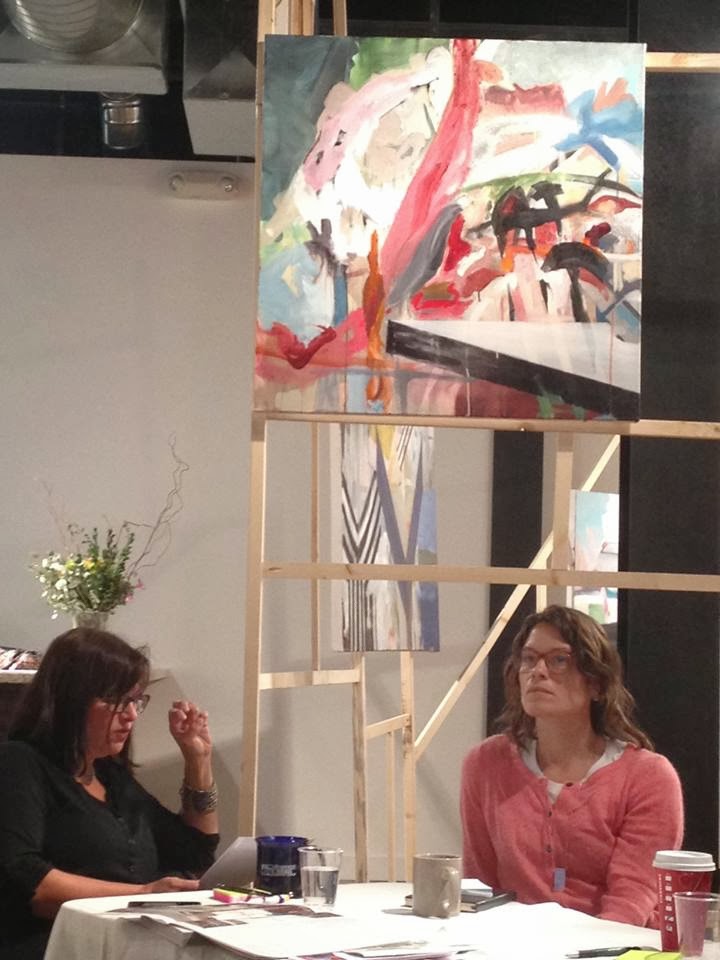
At the beginning of this month, I participated in a panel discussion on Provisional painting.  At the start, I was introduced as a curator and founder of GroundSwell Gallery and as a conceptual artist.  Albeit the moderator did hesitate around the term "conceptual," I found myself befuddled as my mind tried to respond to the larger issue: What kind of artist I am.

This is a familiar topic for me nonetheless.  Most people, upon discovering that I am an artist, ask me, What kind of artist?  Am I a painter?  Or... ?  Most people who are outside of the art community immediately wonder if I am a painter.  I'm amused by this initial thought: Artist = Painter.  I imagine this is a result of one's art education only reaching the middle school level, so familiarity with artists ranged from Monet to Picasso to Pollack to Warhol (MAYBE Warhol).  All painters.

Anyway, my response is usually that yes, I do paintings sometimes, but my art making and media choices are a result of an initial inspiration.  I usually have a vision that relates to philosophy or a personal discovery and that vision leads to a media choice that makes sense.  I just follow my intuition in answering the question, "How can I realize this vision?"  I don't consider myself an expert in any one media, but I do consider myself adept at many media and broadly experienced with various techniques and skill-sets.  Blahdy blahdy blahdy, is this person still listening?  Is what I am saying ringing any bells?  Maybe...  so, sometimes I do paintings.  Sometimes I make sculpture.  I've worked in performance.  I enjoy making large installations, site-specific and otherwise.  Right now, I'm making drawings on paper.  Another aspect of my work is that I tend to work in a very repetitive way.

In the case of the panel discussion, which was also about a vague matter (Provisional painting), I realized I was now talking to a group of people who speak the language of art, of media, of technique and the artist's practice.  These individuals had the background information on the subject and I felt compelled to answer this question more in depth.  However, I was also posed with the categorization of conceptual artist.  I began my response by saying that I had never actually considered myself a conceptual artist, but I could see why she, the moderator, might say so.  My work, being of different media and techniques from project to project, is often linked to a concept, which I describe alongside my work (examples: www.rebeccapeebles.com).  The concept from one project to the next may string along familiar modalities of thinking and working or similar goals despite varied processes toward reaching the goal.  So by the end of my dribbling, befuddled artspeak, I actually said out loud, "Well, maybe you're right.  Maybe I AM a conceptual artist."

No, that's not true.  How bizarre that I walked all around that self-definition-moment undecided, almost desperate to end the tail-spin, and then I just accepted the assumption.  So having given it some thought for a few more weeks, I'll say what I have meant to say for a long time.  I am not a painter.  I am not a sculptor.  I am not an installation artist.  I am not a conceptual artist.  I am not a performance artist.  I am not a print maker.  I am not a textile/fiber artist.  I am not an illustrator.  I wouldn't even call myself an interdisciplinary artist (although that vague term is perhaps the closest fit).

I am an artist.  That is all I am.  I utilize all of who I am and what I know and what I have as I need to.  I make art.
That's enough for me.
I'm certainly not trying to fit into any categories for catalogs or historical documents.  I could care less about my CV or resume.  I even think it's time to re-write my Artist's statement to say less about what kind of artist I am.
There's no reason for me to try to be the right kind of artist or make the kind of art that's popular.  I don't believe in making art for the market or even for an audience - those aims are destructively distracting from my art practice.
I make art for (first) myself and (second) for the love in it and (third) for beauty.

To the moderator of that discussion, thank you for helping me realize who I am not and therefore, who I am... as an artist.

**photo credit - Rebecca Vaughn

Wednesday, October 23, 2013

Moving Day

Today I moved my studio from a 120 sq. ft. room (our 2nd bedroom) to a 600 sq. ft. SPACE (emphasis on the "space").
snapshots of the 14th Ave. Studio (2 yrs of claustro-arto-phobia):
These photos were taken by cramming myself into the opposite corners of the room
and the new 4747 Studio ((sigh) take it all in):
As usual, these photos don't begin to convey the enormous difference this will make for my art making life.

My studio mates: John McEnroe and Bruce Price.  I am stoked.
Here's to a new adventure! 

Saturday, August 24, 2013

I don't know what Art is.

I'm at home sick today so maybe that will explain my wild statement about not knowing what Art is in the subject line.  Or, maybe this is just an expression of Zen knowing and not knowing and I'm about to unleash some real higher thinking right now.

Unlikely.

I bring this up because I just read in the September 2013 of The Atlantic, Out is the New In : Why outsider art - dirty, brutish, and raw - is all the rage by Sarah Boxer.  From what I gather, in my experience as an artist and with running GroundSwell Gallery, the tendency with most artists is to do what they believe is their "art" and it's usually noticeable when the spark of authenticity is not there.  I'd say that meeting the artist and talking with him or her about the art is usually a good test to find out if this is really Art or not.  Sometimes I do come across folks who are making what I would consider to be decoration or very creative design projects.  Sometimes it seems an artist could dive more deeply into his or her art-making but is distracted by the notion of "reaching the audience," pleasing gallerists, or making works that are "consumable" or "priced to sell."  When it really comes to Contemporary Art Trends, it has nothing to do with, on the whole, what artists are making.  When it comes to Outsider Art today, we're all outsiders for the most part...  The insiders are handpicked by a few know-it-alls looking to make money right now.  This is, unfortunately, how our culture is defined now - not as much by authentic expressions in response to our time, but a framing of "culture" utilized to create a market demand.

Sarah Boxer's article expresses that many outsider artists were psychotic in some fashion, "madman," brut, traumatized, and others were just doing their thing, uneducated, but owning it and practicing art-making as an innate calling.  My favorite reference is to Bill Traylor, an African-American artist in Alabama "discovered" by a younger artist, Charles Shannon, who was enchanted by Traylor's serenity in his art making.  In this case and the case of the "brut," the artist is not driven by expectations, ideas, trends and money of the "Art World."

Oh my, that sounds attractive albeit a little isolated.

Then, the isolated artist (maybe he's psychotic, maybe he's a hermetic monk) and, more importantly, his or her artwork are discovered by someone of influence within the upper echelons of the "Art World."  The know-it-alls are enchanted by the never-before-known genius of this artist and see the art as a another get-rich-quick opportunity: "Oh, Auction House B just went nuts over Henry Darger's obsessive paintings of children!  The crazy sh*t this new-found artist makes out of mud and her own feces is going to hit the market like a firecracker!"

I'm starting to sound bitter, and maybe that's because for the lasts 10 - 15 years I mostly believed that any hardworking artist could make a living off of their ARTwork.  At this point in my artmaking life, I don't really think that's true.  Almost every artist I know has other work that supports them and they're lucky if that work is a healthy utility of their creative talent.  It seems to me, especially after reading Don Thompson's The $12 Million Stuffed Shark, that "Making It" as an artist has two very separate meanings.

Making It! option #1:  Make art in such a way as to brand yourself.  Make sure that people know what you look like or what your artwork looks like by creating an indelible propaganda with your art.  Often this entails tapping into the neuroses of our culture streaming out of popular media trends already driven by marketing tactics and economic models.  Hustle.  Get to know as many people hustling as you can - power in numbers!  Always be in the right place at the right time.  Get into publications, known-name-gallery exhibitions, museums, collections and make sure that you are international in your reach.  Then, there's a .0001% chance that someone in the Auction House arena will PICK YOU.  Yesssssss!

Making It! option #2:  Make art in such a way as to increase awareness, increase tactile and emotional intelligence, and increase truth and joy in this world.  Start with yourself.  It takes a lifetime of practice to reach a point where your artwork may affect the larger culture.  Attend to the inspiration that evolves out of your art practice and the life that you live with friends and family and work.  Pay attention to your dreams and to your intuition and make what you envision.  Make what you want to make.  This isn't a dress rehearsal - make what reflects who you know yourself to be.  If you can do this, talent or no talent (remember the outsider artist), there is a 99.99999% chance that you will die happy.   There is also a .0001% chance that someone in the Auction House arena will PICK YOU.  (...whatever...)

What I mean to say is,
No matter what an artist does, whether making art or making propaganda, whether making mud and feces sculptures, or making perfectly square black lacquered cubes, whether working on the inside or the outside, inside-out or outside-in, the chance of "making it" like a rock star is slim to none.  But, the chance of living a happy, fulfilled, self-knowing, wise and serene existence is pretty high.

I say I don't know what Art is because I see it as ephemeral and in flux.  I know that when I look at many works on the walls at museums, galleries, and in my own home, I understand the work to be "Art."  Sometimes I know nothing about the artist, sometimes I know more than enough.  I have tastes and preferences though even work that I don't aesthetically connect to can move me.  I know that when I set about to make art, I am either working from my own inspiration or I'm plagued by a sense of pleasing others.  When I think about Outsider Art and Insider Art, I realize that either can be Art, and that one or the other is being promoted by those in the Art dealing game.

Art Art Art Art Art Art Art Art Art Art Art

Remember that game where you say a word as many times as it takes to begin to lose meaning and seem to be an arbitrary sound coming out of your mouth?  You can do it with any word.  I think it could be important to do that exercise with the word "art" every once in a while so as to remember how arbitrary the word and it's attending subject matter really are.

Now, I'm going to go and look at some art at two different art shows going on in town.  Then I plan to head back home and make some art with 10 lbs. of leftover porcelain clay I've been musing over in my studio for about a year.

Let it be known that my opinions change and my knowledge is always being reformed. 

Monday, March 4, 2013

new to the collection

Currency Andrew Speer, oil and acrylic on linen, 16" x 20"
Thrilled to have a new painting in my art collection!  This work by Denver Artist, Andrew Speer, was just a part of GroundSwell Gallery's exhibition, Provisional.  Andrew's paintings, however provisional they may be, are refreshingly of the moment.  The title, Currency, may be as much about money as it is "the quality or state of being current."  This currency for me is the moment of release - when you've let go of the work and it's flying off to the sky though you still feel the energy in your heart and hands from making it.  Thank you to Andrew for giving rise to this feeling in me each time I pass near your work in my home.

Wednesday, August 29, 2012

ceramics for the summer

This Summer, I decided to take on a new installation project after an April conversation with Jordan from Denver's Forest Room 5 (Restaurant, Bar, Lounge, Night Club, and more recently - Gallery).  The offer was simple, they have a newer large room (I call it the tree-house) where DJ's play out to crowds and the walls are dedicated to monthly art exhibits.  I decided to do an installation that I felt could interact with this thematically rich space.  Henceforth, a plan to create as many bells out of porcelain as I could and figure out a way to install them along a long wall in the space. I wanted to continue work that addresses a concept I've been addressing in my work lately - cryptic or obsolete language, while also creating a piece that interacts with the "trees" at Forest Room. 

I talked about cryptic language in an earlier post about a drawing I made for the Exquisite Corpse project at my gallery, GroundSwell.  The idea of creating works that have a message though the message is not entirely obvious or understandable to most, makes sense to me as a way of avoiding a didactic or even trite nature.  I have a subtle irritation with artwork that poorly uses statements or words (so obvious, too moralistic, awkwardly immature, etc.), so I try not to use words in my work.  ...lately, I can't help myself as I realize I can make the message or the words only known to me and maybe a few focused, intent, or just in-the-know individuals.  This work is about the obsolescence of bells and their "language" of timbre and pitch, timing and number, but it is also about the constant language of "ring tone" in the contemporary bell or chime known as a cell phone.  It's a note that says, "oh yeah, remember these?" to my peers and also says to the chicos, "Hey kids, this is what a ring tone used to come from!"  I know bells aren't extinct, but...  you know, I just love bells and I think it's interesting that I love something that is now becoming a sentiment or nostalgic item of antiquity.   This artwork is titled, Tinnient Campana. 
So this summer, I worked on Tinnient Campana for daaaaays at the Art Students League of Denver (which is awesome) with Barry Rose (who really knows his stuff when it comes to ceramics) to make by hand as many porcelain bells and clappers (the piece that strikes the bell from the inside) as I could.  There are 108 of them.  I'm exhibiting 99 in groups of 3.  The purpose of installing a large number is to identify the proliferation of "ring tones" in our lives and the relationship to the origin of the ring tone. All 33 sets of 3 go on exhibit this coming Saturday at Forest Room 5 (2532 15th Street Denver, Co 80211).  I hope you'll take the time to drop by and see this new work before the end of the show on October 2. 

Thursday, April 12, 2012

Sunday, April 1, 2012

 "Disappearing, and other long term goals." 
Jeffrey King introduced this concept to us at GroundSwell Gallery as the central point from which his body of work would operate.  The work pictured above, titled as the show, is Jeffrey's quietly bold visual comment regarding our temporary status in our shoes, on this ground, standing, here...  With most of the works for Jeffrey's current exhibition (up through April 10), we are directed by elaborate "pointer sticks" to associate images with colors and shapes.  Maybe the colors and shapes indicate the arbitrary nature of things to which we attach ourselves.  The stylistically ephemeral drawings depict a place, a thing, a "Memento" of our existence, our memory - that to which we may attach meaning to ourselves.  King's choice of objects with which we self identify (speaking of our collective humanity from the artist's perspective) run the gamut, ranging from a "Have a nice day" smiley plastic bag to the icon of American architecture, Falling Water a building designed by Frank Lloyd Wright.  Working together, the framed drawings, pointer sticks and colored shapes create a sort of mind map that sets us off balance until the humor sets in.

We at GroundSwell Gallery would like to thank Jeffrey King for his outstanding work and work ethic. 

GroundSwell gallery is located at 3121 E. Colfax Ave.  We invite the public to visit the gallery Monday through Saturday 11a - 7pm and Sunday 12 - 6pm.

Friday, March 2, 2012

drawing dance - Tony Orrico

Tony Orrico tells about his work throughout this video by Becky Reamer, so I won't go into the details.  I will say, if I were a dancer...

Sunday, January 29, 2012

James Llorca Garcia Marquez


A good Denver artist, James Llorca Garcia Marquez is leaving.  I'm staying, but I don't blame him, and I sympathize with his statements made in this Westword article about his departure to NYC.  I have 2 small pieces of his, tiny books, that I found while working at Hooked on Colfax, and I often feel grateful about the inherent generosity of having them.    I looked forward to seeing where this artist would begin to show in Denver and how he might grow.    Anyway, I'll miss this guy.
Composite, Physiognomic


I  too want Denver to start paying attention to Denver's artists and quit remarking on "how expensive" art is.   At least give these artists the honor of never knowing that you think the work is "expensive" - it is a matter of opinion after all - because art, when it is really art, is too important a thing to make such tactless remarks about dollars.
To James,
I hope you keep working.  Good luck and Farewell.

Friday, January 27, 2012

Takeo Hiromitsu

Matrimonial Kosmonauts mixed media on panel 17x43"
GORG mixed media on panel 14x14"

Prints and paintings by Takeo Hiromitsu are now showing at GroundSwell Gallery.  It's been a roller coaster of learning "how to do this gallery thing" with Danette, but I at least realize where the upsides are really up.  Month after month, we have these talented, serious, hard working artists bringing good art to our new(ish, 8 months!) space on East Colfax Ave, Denver, and the coming scheduled months bring more of them.  Denver's artists aren't dreamers.  They're doers.  The art is here and we're not the only space to show for it.  We hope you'll visit GroundSwell and see Takeo's work in our bright little gallery.  Take time to look at the details, see the narrative of this "self exist(ing) to connect with the cosmic creative energy that has churned time."  Mr. Hiromitsu's paintings and prints reconnect us with the chaos and fury of living that ultimately settles us out as we find our flow.
bigheadsmallcrown Lithograph print 25x20"


Takeo Hiromitsu
paintings and prints
on view at GroundSwell Gallery
Through February 7, 2012

3121 E. Colfax Ave.
Denver, CO 80206

GroundSwell is open
Monday - Sat. 11a - 7p and
Sundays 12 - 6pm

for more information or a scheduled viewing, please email:
rebecca@groundswelldenver.com
danette@groundswelldenver.com 


Friday, December 16, 2011

Rozie Vajda at GroundSwell Gallery

What a fun month at the gallery with the complex and beautiful characters created by Rozie Vajda.  Each marionette with it's own detailed expression, components, and stage is an example of Rozie's true investment into the whole creation of personality and placement.  We are honored to show this work and we welcome you, if you haven't already, to visit GroundSwell Gallery during this heartwarming season - open through January 10, 2012. 

GroundSwell Gallery is located at 3121 E. Colfax Ave. Denver, CO 80206 (Bluebird District). 

Open Monday - Saturday 11am - 7pm, Sunday 12 - 5pm

Monday, December 5, 2011

“I like to think that some of my work at least will stay in the present tense.”

Ellsworth Kelly at the Boston Museum of Fine Arts.  Not his usual paintings, but his wood sculptures.  Just wanted to link to this NYTimes Article including some statements from Kelly himself.  I am especially interested in artists like this who are interested most in remaining in the present tense.  This image is of Spectrum V, 1969.  I remember seeing this on a visit to see art somewhere in the world...  Anyway, I remember loving it. 

Thursday, November 17, 2011

City Smiles

Today an Open House at City Smiles Dentistry, 100 Spruce Street, Suite 100 Denver, CO 80230.  Everyone is invited from 5:30p - 8:30p.  This is a great chance to see what Chelsea Mayer, DDS has done to build out a beautiful new dentist office that all who care about design and good space can really enjoy!  She smartly requested good art curation for the office and I reached out to local Denver Artists.  The result, the best dressed Dentist office I've ever been to!  I'm honored to work with the artists:
Sara Guindon
Sandra Fettingis
Rob Mack
Shayna Cohn
Debbie Clapper
Alan Kitchen
Paul Langway
Bethany DeMarco
Derek Keenan 
Jared David Paul

Monday, November 14, 2011

Rozie Vajda at GroundSwell - through Jan. 10

I call this a successful art opening.  The highly detailed and exquisitely constructed characters that are Rozie Vajda's marionettes now grace GroundSwell Gallery.  I am so proud to curate with such a talented and hard working artist!

Please visit the gallery before Jan. 10, 2012 to see this incredible show. 

Below, please find Rozie Vajda's artist statement. 

"I work with found objects. Some discarded, some given, others forgotten, all rediscovered and repurposed. I help these treasures discover a new life with new companions in a new story.

My studio has a floor to ceiling collection of these found, gifted, and salvaged treasures and art parts collected over a lifetime. Chosen for the emotion as much as the aesthetic, in this show can be found roots, twigs, and seaweed, accordion parts and the keys to my first car. When these parts make their way into my art, so too do the people, places, and experiences they represent.

In these most recent pieces, my explorations with assemblage art, doll-making, sewing and felting have come together in a whimsical way that surprises and delights me. With the pull of a string these characters come to life with motion and dance."

-Rozie Vajda

Tuesday, October 18, 2011

3115)| +! |(3121 East Colfax Ave.


MAD KING  In Transit  2011
Running the gallery at GroundSwell with Danette Montoya has been immensely enjoyable for me in the months since we opened in May 2011.  I find that I have more fulfilling and inspiring conversations with artists around Denver than I would have thought available to me.  I happily do this work and I'm inspired to keep on with my own art work.

The current show at the gallery with MAD KING is definitely worth a visit.  GroundSwell is open daily from 10a - 7pm and this show runs through November 8th.  If you're like me, you may find yourself brightened by MAD KING's layered patterns, colors, textures and characters.  I especially invite those interested in enriching their visual promotion and representation materials with the skillful and soulful imagery of this artist.
http://www.madkingproductions.com/

Finally, I want to share, through pictures (below), the happenings between 3115 East Colfax and 3121 East Colfax (GroundSwell).   Artists working this week, and pictured in the first photo here are Denver's own Max Kaufman and Nice One, Denver native, now working from Chicago. 

Max Kaufman and Nice One work out the details of what will be a very large mural on the side of GroundSwell Gallery and Cannabis Boutique

newest stencil in the past month

This wheat pasted painting appeared in the past month as well.  We're into that on our unpainted brick wall, but the stencil to the Right is totally inconsiderate of the brick material.  Boo.  Also, see left, part of Paul Langway's mural from last Summer on the low wall bordering the alley.


"Own Your Soul, Monster."  We're especially into the painting, being not the expected xerox, and the poeticism of this wheat paste.
In closing,
Thank you Denver Artists.